The Directions of Technical Change
Miklós Koren
Zsófia Bárány
Ulrich Wohak
2026
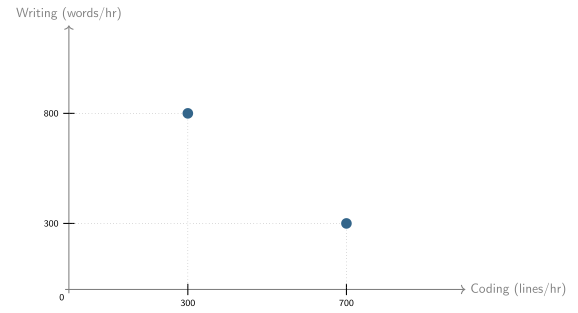
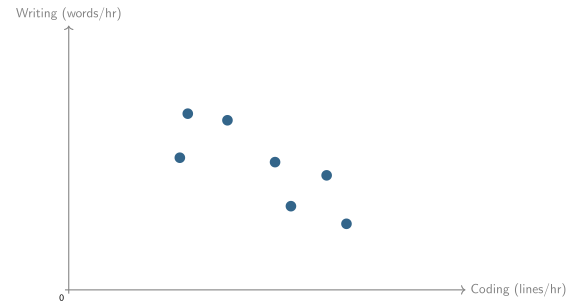
Suppose we observe a worker doing two tasks
![]()
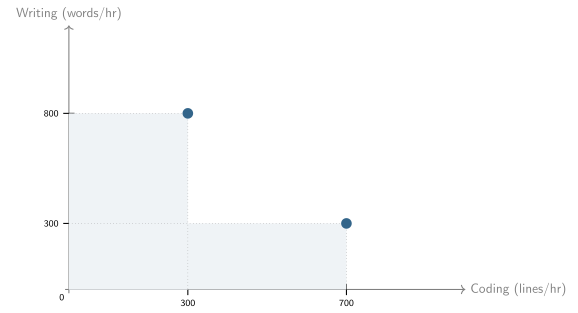
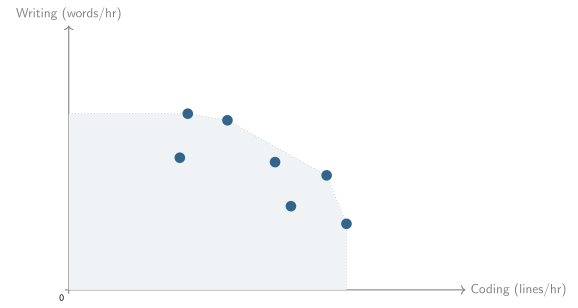
The worker can also do less: free disposal
![]()
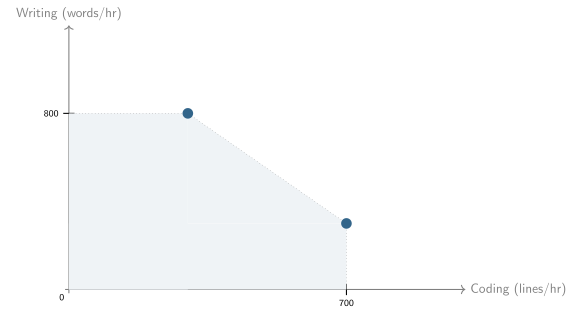
Time can be split across tasks: convex hull
![]()
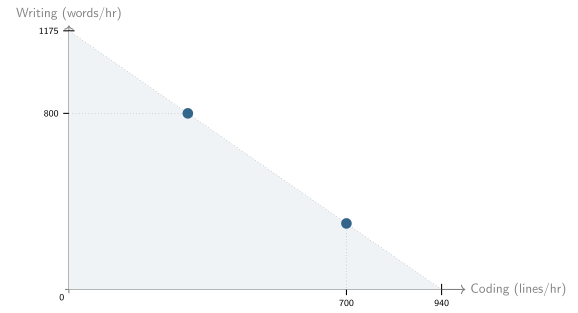
With perfect substitution: linear production possibility set
(PPS)
![]()
Many observed tasks for the same worker
![]()
PPS is the convex hull
![]()
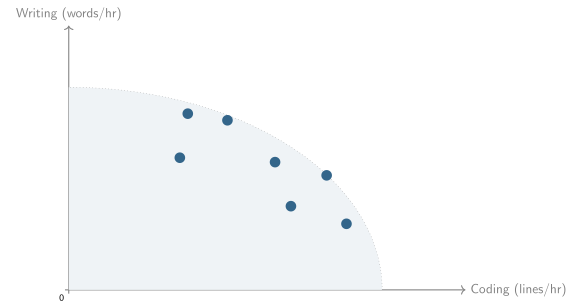
Smooth approximation: constant-elasticity PPS
![]()
Ingredients
- Human capabilities bundled in a convex production possibility set
(PPS)
- AI capabilities limited by human supervision/attention time
- (Flexible task allocation responsive to skills and job
requirements)
The worker’s problem
\[\max_{x} \; F(x) = \left(\sum_{i=1}^N
\theta_i^{1/\sigma}
x_i^{1-1/\sigma}\right)^{\sigma/(\sigma-1)}\]
subject to
\[
\left(
\sum_{i=1}^N (x_i/s_i)^{1+1/\gamma}
\right)^{\gamma/(\gamma+1)} \leq B
\]
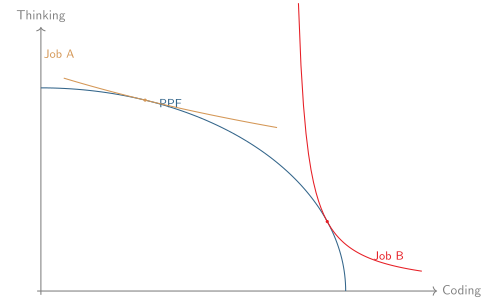
\(x\) = activities, \(\theta\) = job requirements (CES), \(s\) = skills (CET), \(B\) = time in a day.
\(\gamma\) = elasticity of
transformation (PPF curvature)
\(\sigma\) = elasticity of
substitution (isoquant curvature)
Different jobs have different requirements
![]()
Optimal task mix depends on skills and requirements
\[
x_i \propto s_i^{(1+\gamma)\sigma/(\gamma+\sigma)}
\theta_i^{\gamma/(\gamma+\sigma)}
\]
Productivity is a CES-weighted average of skills
Output per unit of time \[
\Phi =
\left[\sum_k
(s_k^{\sigma-1} \theta_k)^{(\gamma+1)/(\gamma+\sigma)}
\right]^{(\gamma+\sigma)/[(\gamma+1)(\sigma-1)]}
\]
Jevons’ Paradox
Time share on activity \(i\): \[
\omega_i^A =
\frac{(s_i^{\sigma-1} \theta_i)^{(\gamma+1)/(\gamma+\sigma)}}
{
\sum_k
(s_k^{\sigma-1} \theta_k)^{(\gamma+1)/(\gamma+\sigma)}
}
\]
Increases in skill \(s_i\) if \(\sigma > 1\). Relevant range for
knowledge work.
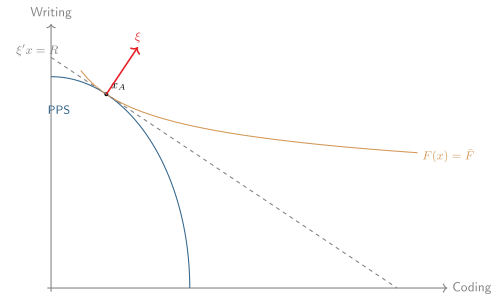
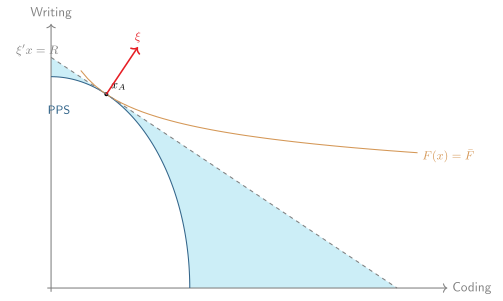
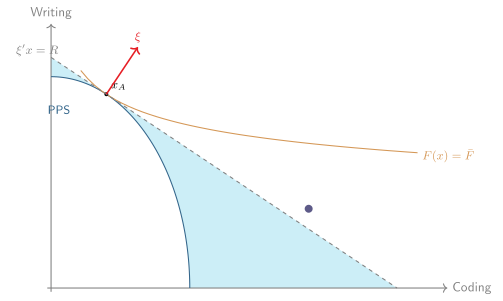
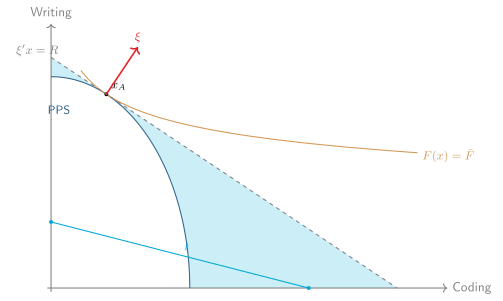
Shadow prices express scarcity (marginal cost of human time)
\[
\xi_i =
\left(\frac{\theta_i}{s_i^{1+\gamma}}\right)^{1/(\gamma+\sigma)},
\]
High for activities that are required (\(\theta_i\) high) but hard to do (\(s_i\) low).
Shadow prices
![]()
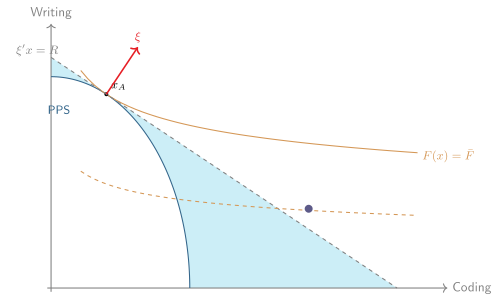
The budget set is larger than the PPS
![]()
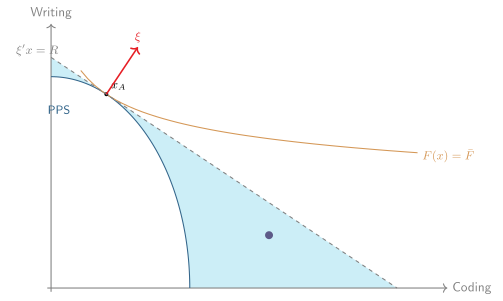
Suppose a machine can provide this amount of code and writing per
hour
![]()
Would you buy it?
![]()
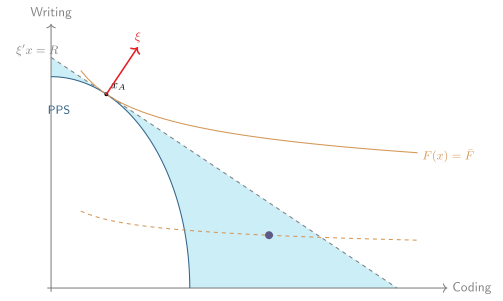
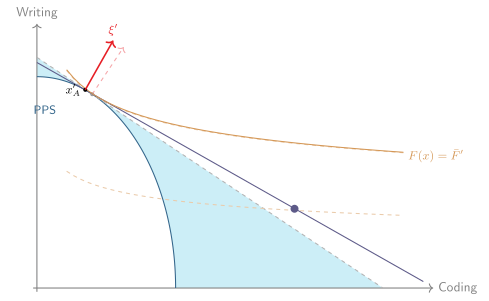
How about now?
![]()
AI alone is still worse than human alone
![]()
But AI + human now better
![]()
What can AI do?
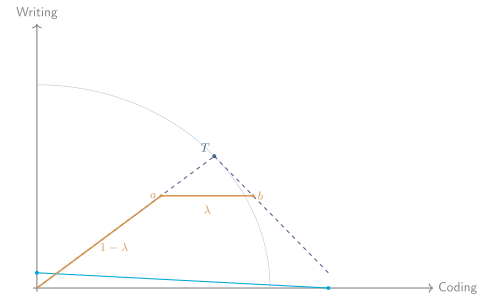
AI can perform any combination of \(\{t_1,
\dots, t_N\}\) tasks, but requires supervision.
\[
\max_{x, x_{\text{human}}, \mu} \; F(x)
\] \[
x_i = x_{i,\text{human}} + \mu_i t_i
\] \[
\sum_i \mu_i + g(x_{\text{human}})\leq B
\]
AI + human = convex hull
\[
X_{AI} = \{x : \sum_i x_i/t_i \leq \mu B\}
\]
\[
X_{\text{human}} = \{x : g(x) \leq (1-\mu)B\}
\]
\[
X = X_{\text{human}} + X_{AI}
= \{x : x = x_1 + x_2, x_1 \in X_{\text{human}}, x_2 \in X_{AI}\}
\]
AI + human = convex hull
![]()
AI has an absolute but not comparative advantage
![]()
More capable AI will get used for coding
![]()
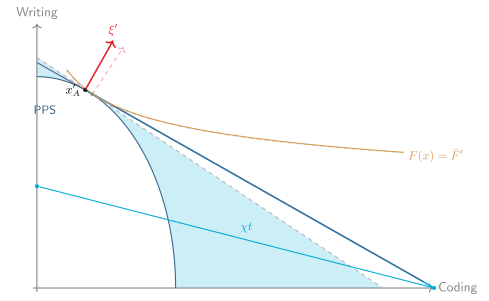
When to adopt AI?
Whenever the value of AI tasks,
evaluated at the shadow prices of the human PPS,
exceeds your current output.
Adopt AI for first task \(i\)
\[
t_i > \left(
\frac{\gamma}{\gamma+1}
\right)^{\gamma/(\gamma+1)}
s_{i}
\omega_{oi}^{-1/(\gamma+1)}
\]
\[
\frac{t_i}{s_i} > \left(
\frac{\gamma}{\gamma+1}
\right)^{\gamma/(\gamma+1)}
\omega_{oi}^{-1/(\gamma+1)} > 1 \qquad \text{if } \gamma < \infty
\]
Multitask adoption
Order tasks by highest \(\omega_{oi}^{1/(\gamma+1)}t_i/s_i\).
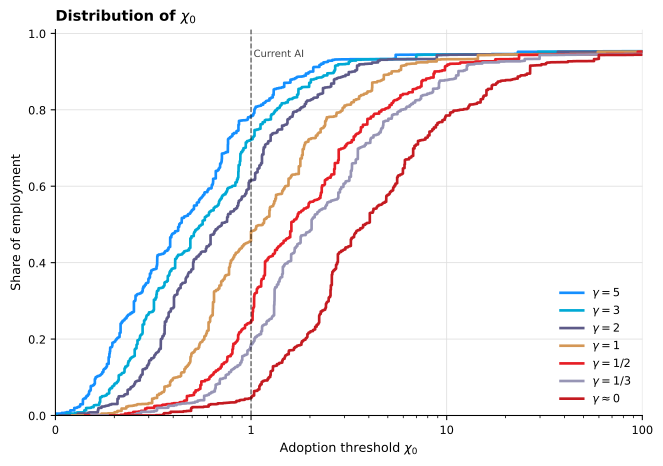
There exist \(\chi_1 < \chi_2 < \dots
< \chi_N\) such that AI is used for the first \(k\) tasks if and only if \[
\chi_{k+1} \geq \omega_{oi}^{1/(\gamma+1)}t_k/s_k \geq \chi_k
\]
The general structure
All results depend on convexity, not on CES–CET:
- Any convex PPS \(X_A = \{x : g(x) \leq
B\}\) with quasi-convex hom(1) production function \(F\)
- Shadow prices \(\xi\) defined by
tangency (supporting hyperplane)
CES–CET gives closed forms; the geometry works for any \(F\) and \(g\).
Convexity is a reduced-form way to capture task complementarity
within a fixed time budget.
Model predictions
- Region of non-adoption: absolute advantage is not enough.
- Fast adoption but small productivity effects past this
threshold.
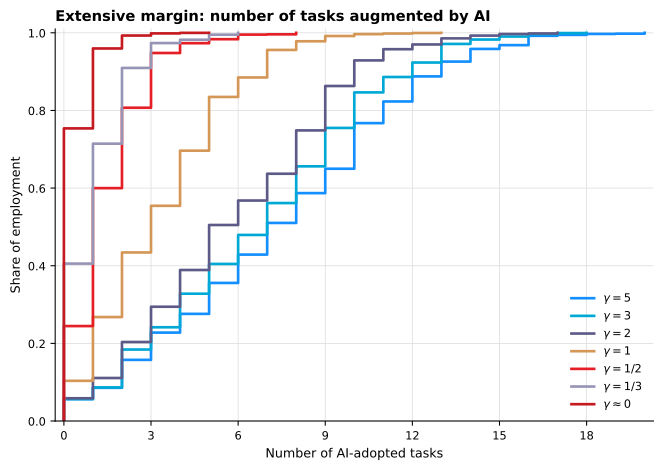
- Intensive margin: Partial adoption even for augmented tasks
- Different jobs augment+automate different tasks.
Shout-outs
Manuelli & Seshadri (2014)
Neoclassical theory explains slow adoption of tractors (\(\varepsilon_{\text{horse}, \text{tractor}} <
\infty\)).
Garicano, Li and Wu (2026)
Human capabilities in strong bundles serve as bottlenecks to
AI.
Freund and Mann (2026)
Automation reshapes the task mix of jobs (\(\sigma=1, \gamma=\infty\)).
Jones (2025)
Complementarity (low \(\sigma\))
matters for progress more than benchmarks (\(t_i\)).
Data sources
Antropic Economic Index (AEI)
Task success rates, human times and AI times for O*NET tasks, March
2026. Aggregate to 332 Intermediate Work Activities (IWAs).
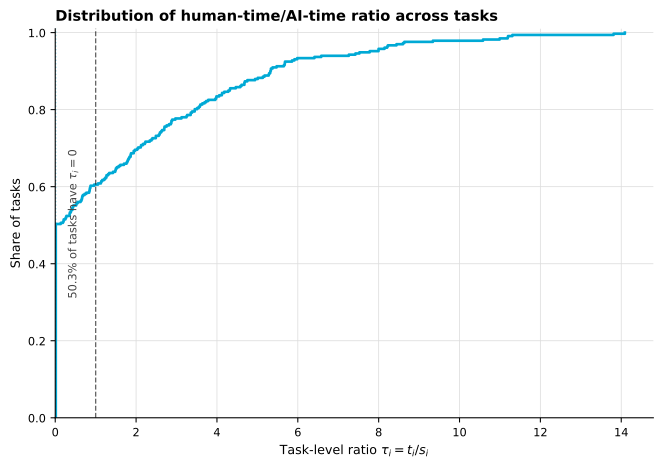
\[
\tau_i = \frac{t_i}{s_i} = \frac{\text{human time}}{\text{AI
time}/\text{success rate}}
\]
O*NET occupational task
frequencies
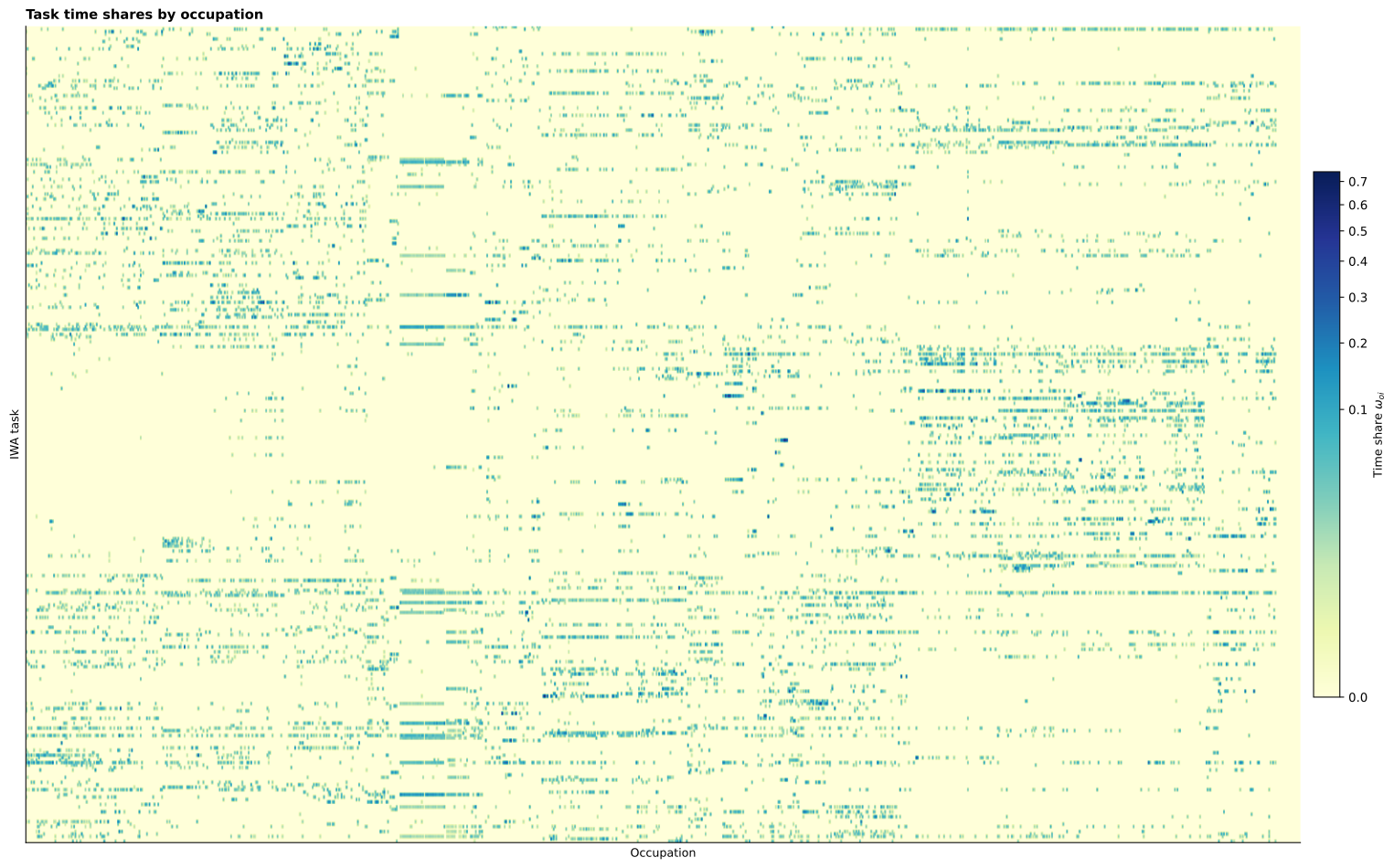
Use task frequnencies \(\lambda_{oi}\) (daily, weekly, etc) and
approximate \[
\omega_{oi} \approx \frac{\lambda_{oi}}{\sum_j \lambda_{oj}}
\]
Task time shares across 1,016 occupations
![]()
Task-level human-time/AI-time ratio
![]()
Distribution of adoption thresholds
![]()
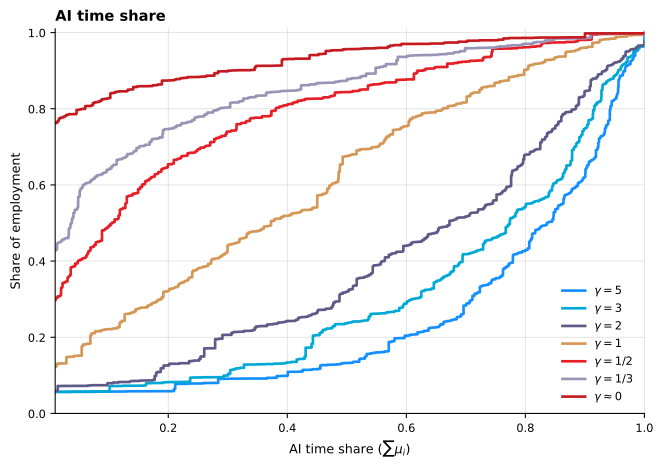
AI time share
![]()
How many tasks does AI augment?
![]()
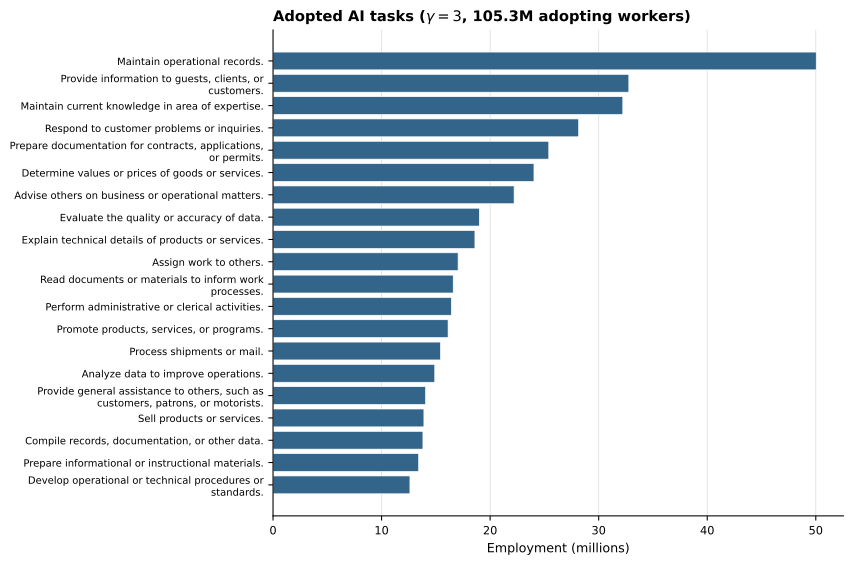
Which tasks get adopted first?
![]()
Acknowledgements
This research was funded by the European Union under the Horizon
Europe grant 101061123 and by the National Research, Development and
Innovation Office (Forefront Research Excellence Program contract number
144193). Views and opinions expressed are those of the authors only and
do not necessarily reflect those of the European Union, the European
Commission, or the National Research, Development and Innovation
Office.